MS Angles and Tees in Kenya: Sustainable Steel Fabrication for Modern Architecture | BHD
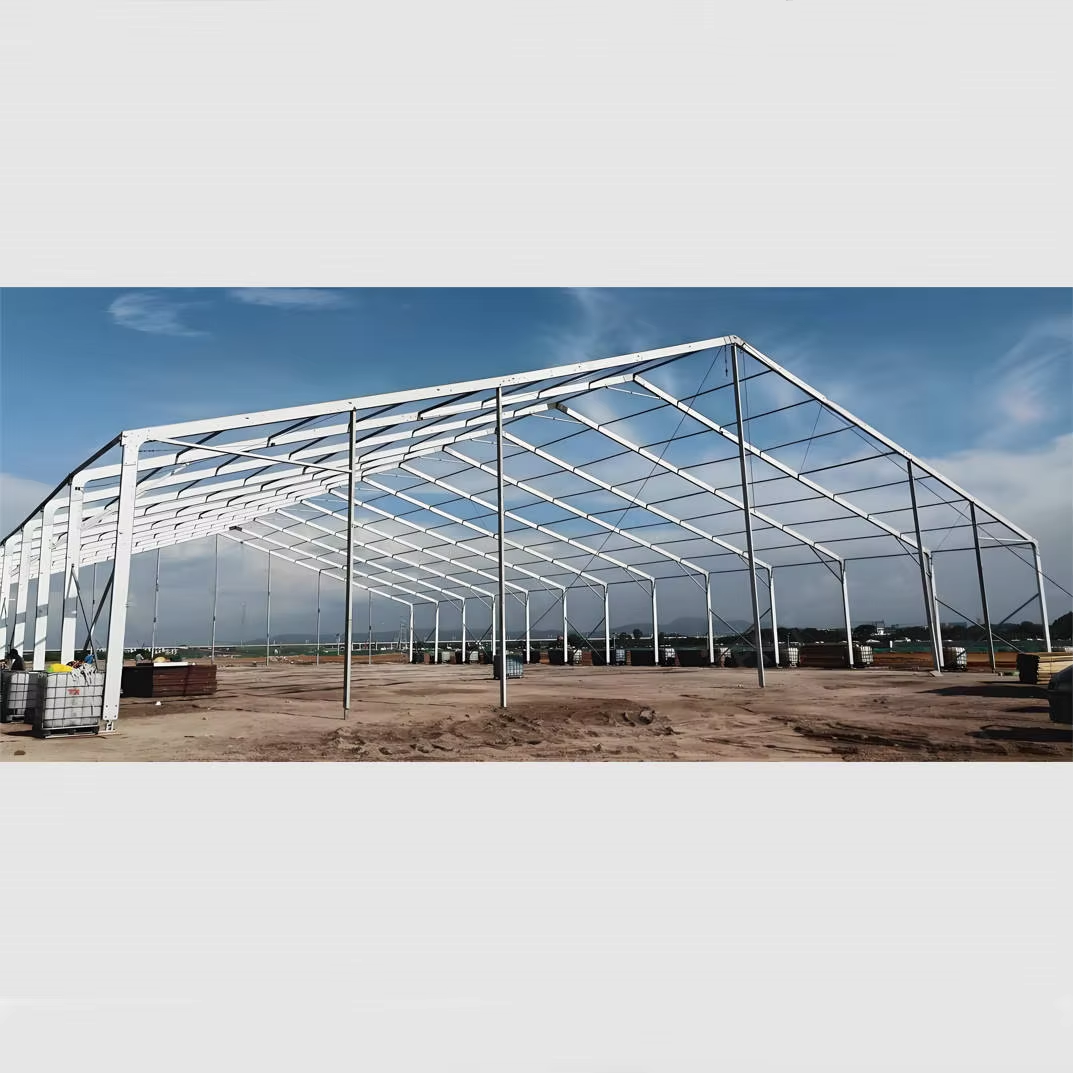
Steel fabrication provides the structural backbone for durable, scalable, and resource-efficient buildings.
It enables faster construction, reduced material waste, and adaptable architectural designs suited to Kenya’s urban growth.
From Nairobi’s commercial towers and industrial parks to schools, hospitals, warehouses, and residential developments across counties, fabricated steel components are now integral to Kenyan architecture. Compared to traditional masonry-heavy systems, steel-based construction offers:
-
Faster build times
-
Predictable structural performance
-
Lower long-term maintenance
-
Easier integration with green building strategies
MS angles and tees are among the most widely used fabricated sections due to their simplicity, versatility, and structural efficiency.
What Are MS Angles and MS Tees?
MS Angles and MS Tees are hot-rolled mild steel sections used extensively in structural framing and fabrication.
They provide strength, connection points, and load distribution while remaining economical and easy to fabricate.
MS Angles
MS angles have an “L-shaped” cross-section and are available as:
-
Equal angles (both legs same size)
-
Unequal angles (legs of different sizes)
They are primarily used for:
-
Bracing
-
Framing
-
Connections
-
Trusses and lattice structures
MS Tees
MS tees have a “T-shaped” cross-section, often produced by splitting I-beams or rolling directly. They are used for:
-
Secondary beams
-
Load distribution members
-
Roof and floor framing support
Together, these sections form the building blocks of many sustainable steel frameworks in Kenya.
How Have MS Angles and Tees Evolved in Kenyan Construction?
The use of MS angles and tees has shifted from purely functional roles to integral components of engineered and sustainable design.
They are now specified with greater precision, documentation, and compliance than in the past.
Early Use
Historically, MS angles were mainly used for:
-
Simple sheds
-
Agricultural structures
-
Light industrial buildings
Designs were often empirical, with limited engineering analysis.
Modern Application
Today, MS angles and tees are:
-
Engineered using structural software
-
Integrated into hybrid steel–concrete systems
-
Designed to meet performance-based codes
-
Optimized to reduce steel tonnage and carbon footprint
This evolution aligns with Kenya’s shift toward regulated, performance-driven construction.
Why Are MS Angles and Tees Important for Sustainable Architecture?
Sustainable architecture prioritizes material efficiency, durability, adaptability, and reduced environmental impact.
MS angles and tees support these goals through smart structural design and fabrication efficiency.
Material Efficiency
Angles and tees allow engineers to:
-
Use steel only where required
-
Reduce oversized members
-
Achieve high strength with minimal material
Reduced Waste
Fabrication using standardized sections:
-
Minimizes offcuts
-
Enables reuse and recycling
-
Reduces on-site waste compared to cast-in-place methods
Long Service Life
When properly protected against corrosion, MS sections can last decades with minimal intervention.
Adaptability and Reuse
Steel frameworks using angles and tees can be:
-
Modified
-
Extended vertically or horizontally
-
Disassembled and reused
This flexibility supports circular construction principles.
How Do MS Angles Function Structurally?
MS angles primarily resist tensile and compressive forces and provide lateral stability.
They are especially effective in bracing systems and trussed structures.
Structural roles include:
-
Wind and seismic bracing
-
Truss members in roofs
-
Support for stairs and platforms
-
Connection elements between beams and columns
Angles are particularly valuable in lightweight yet stiff structural systems, making them common in sustainable and modular designs.
How Do MS Tees Contribute to Structural Performance?
MS tees efficiently resist bending and distribute loads across supporting members.
They are often used as secondary structural elements in floors and roofs.
Key functions:
-
Supporting slabs or decking
-
Acting as edge beams
-
Distributing loads from floors to primary beams
-
Supporting façade systems and sunshades
Tees offer a balance between strength and material economy, aligning well with green building objectives.
Typical Applications in Sustainable Kenyan Architecture
MS angles and tees are used across a wide range of building types and scales.
Their versatility supports both functional and architectural requirements.
Common applications include:
-
Steel roof trusses for commercial and residential buildings
-
Bracing systems in multi-story frames
-
Façade support structures
-
Walkways, ramps, and staircases
-
Solar panel mounting frames
-
Canopies and shading devices
In sustainable designs, these elements are often left exposed, reducing finishing materials and celebrating structural honesty.
Standard Sizes and Specifications Used in Kenya
MS angles and tees are produced in standardized sizes suitable for most structural and fabrication needs.
Selection depends on load requirements, span, and design intent.
Typical MS Angle Sizes
| Size (mm) | Approx. Weight (kg/m) | Common Use |
|---|---|---|
| 25 × 25 × 3 | ~1.1 | Light framing |
| 40 × 40 × 5 | ~3.0 | Trusses, bracing |
| 50 × 50 × 6 | ~4.5 | Structural support |
| 75 × 75 × 6 | ~6.8 | Medium structural roles |
| 100 × 100 × 8 | ~12.0 | Heavy bracing |
Typical MS Tee Sizes
| Tee Depth (mm) | Approx. Weight (kg/m) | Application |
|---|---|---|
| 50 | ~4.0 | Light support |
| 75 | ~6.5 | Secondary beams |
| 100 | ~9.5 | Floor and roof framing |
| 150 | ~14.0 | Heavier loads |
Actual specifications should always be confirmed against mill certificates and design requirements.
Performance in Kenyan Climate Conditions
MS angles and tees perform reliably across Kenya when corrosion protection matches environmental exposure.
Climate-aware detailing is essential for sustainability and durability.
Nairobi & Central Highlands
-
Moderate humidity
-
Painted or primed steel sufficient for most indoor and covered applications
Coastal Regions (Mombasa, Malindi)
-
High humidity and salt-laden air
-
Galvanizing or high-performance coatings recommended
Western Kenya & Lake Basin
-
High rainfall
-
Emphasis on drainage, protective coatings, and inspection
Good corrosion protection significantly extends service life and reduces replacement-related environmental impact.
Fabrication and Installation Best Practices
Sustainable steel construction depends as much on workmanship as on material choice.
Proper fabrication ensures safety, efficiency, and longevity.
Best practices include:
-
Accurate cutting and drilling to reduce waste
-
Certified welding procedures
-
Proper alignment and bracing during erection
-
Protection of cut edges with primer or zinc-rich paint
-
Use of bolted connections where future disassembly is anticipated
Prefabrication off-site further improves quality control and reduces on-site disturbance.
Compliance with Kenyan Regulations (2026)
Structural steel fabrication must comply with national safety, quality, and tax regulations.
Compliance supports sustainability by ensuring performance and accountability.
National Building Code 2024
-
Emphasizes performance-based structural safety
-
Requires documented engineering design and material traceability
KEBS Standards Levy 2025
-
Ensures conformity to quality standards
-
Applicable to locally manufactured and imported steel products
KRA eTIMS (Effective Jan 1, 2026)
-
All MS steel purchases must be supported by valid eTIMS invoices
-
Required for tax deductibility and project audits
Using compliant materials avoids rework, penalties, and safety risks.
Cost and Lifecycle Value of MS Angles and Tees
While MS angles and tees are relatively affordable, their real value lies in lifecycle performance.
Efficient design reduces steel tonnage, labor, and long-term maintenance costs.
Cost factors include:
-
Section size and weight
-
Steel grade
-
Fabrication complexity
-
Surface protection
-
Transport and installation
Sustainable projects assess whole-life cost, not just initial material price.
Common Design and Fabrication Mistakes to Avoid
Errors in specification or execution can undermine sustainability goals.
Avoiding common mistakes ensures performance and safety.
Common issues:
-
Oversizing sections “for safety” (material waste)
-
Ignoring corrosion environment
-
Poor welding quality
-
Inadequate bracing design
-
Lack of documentation for compliance
Early collaboration between architects, engineers, and fabricators prevents these problems.
The Future of MS Angles and Tees in Kenyan Architecture
MS angles and tees will remain central to Kenya’s sustainable construction landscape.
Their simplicity, adaptability, and recyclability align with future building trends.
Emerging trends include:
-
Modular steel construction
-
Hybrid steel–timber systems
-
Increased reuse of structural steel
-
Digital fabrication and BIM-driven detailing
-
Greater emphasis on exposed structural aesthetics
These trends reinforce the relevance of angles and tees as low-waste, high-performance structural elements.
Why MS Angles and Tees Are Essential for Sustainable Kenyan Architecture
MS angles and tees enable efficient, adaptable, and durable structural systems.
They support Kenya’s move toward regulated, environmentally responsible construction.
Their benefits include:
-
Structural efficiency
-
Reduced material waste
-
Long service life
-
Ease of fabrication and modification
-
Compatibility with green building strategies
When properly designed and protected, they contribute meaningfully to sustainable architecture across Kenya.
Contact Burhani Hardware Dealers (BHD)
For high-quality MS angles, MS tees, and professional guidance for sustainable construction projects:
Email: burhanihardwaredealers@yahoo.com
Call/WhatsApp: +254 731 217 462 | +254 704 606 131
Visit: BHD, Industrial Area, Funzi Road, Nairobi
Website: https://bhd.co.ke/
Delivery Guarantee:
-
Same-day delivery within Nairobi
-
Next-day delivery countrywide to Nakuru, Kisumu, Mombasa, Eldoret, Thika, Meru, Kitengela, and Malindi