TMT Bars vs Twisted Bars in Kenya: 2026 Guide to Strength & Differences | BHD Kenya
Quick answer
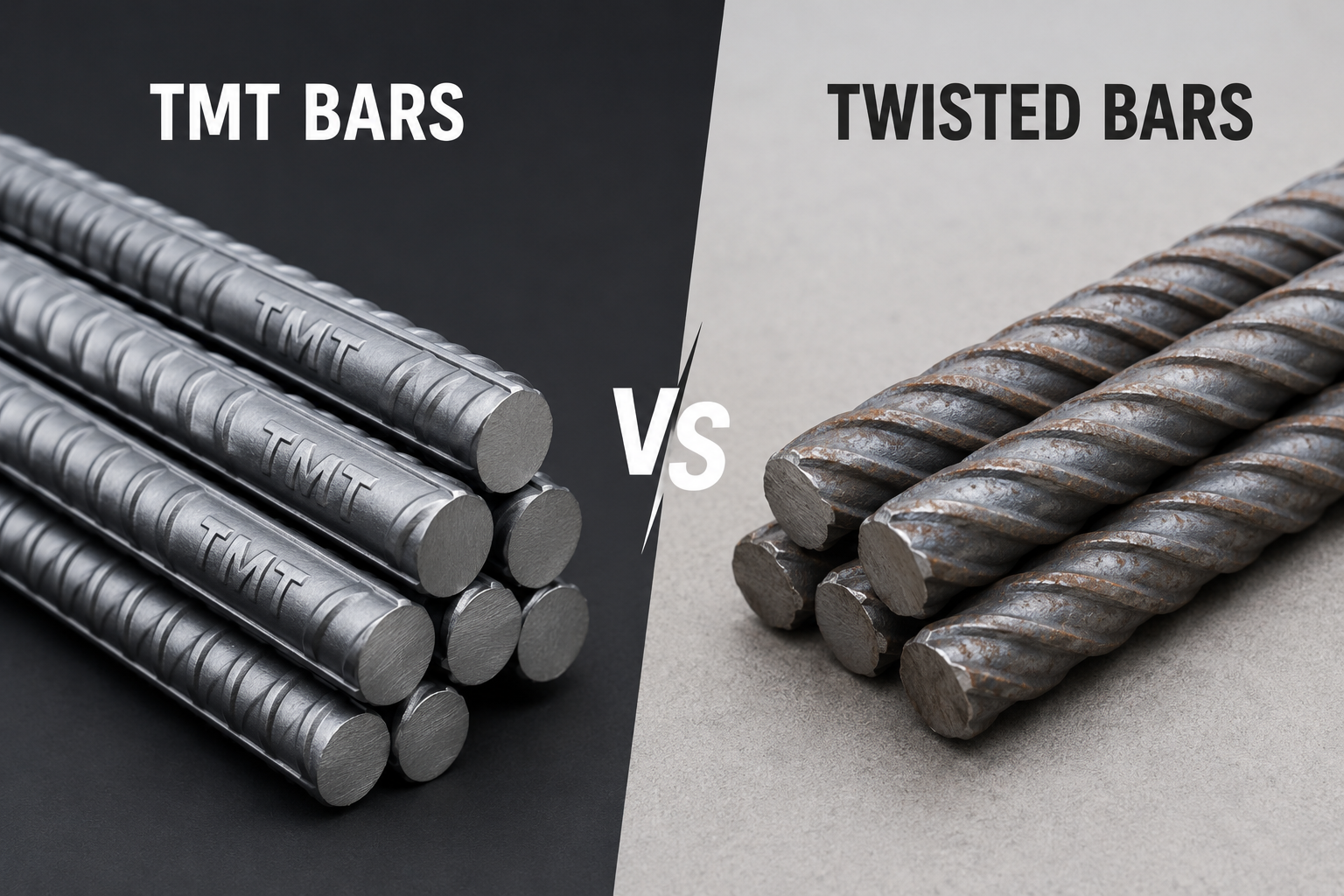
TMT bars are thermo-mechanically treated, quenched at the surface and left with a softer core, giving a hard outer layer with a ductile centre that bends without cracking. Twisted bars gain strength by cold twisting, which leaves locked-in stress and a rougher surface. TMT is the modern reinforcement standard for Kenyan concrete work.
Reinforcement steel determines how well a structure handles load, stress, cracking, and long-term environmental exposure. In Kenya, the most discussed reinforcement options are TMT (Thermo-Mechanically Treated) bars and traditional twisted steel bars. While both are used in concrete reinforcement, their performance, safety levels, and compliance with modern building standards differ significantly.
This guide compares both materials in a practical, engineering-focused way to help contractors, engineers, and developers choose the right reinforcement steel for Kenyan construction conditions.
What Are TMT Bars?
TMT bars are high-strength reinforcement steel bars produced through thermo-mechanical treatment, giving them a hard outer surface and a ductile inner core. They are designed to improve strength, flexibility, and resistance to structural failure.
TMT bars are widely used in modern construction because they:
- Resist high structural loads
- Bend without breaking under stress
- Bond effectively with concrete
- Perform well in seismic and dynamic conditions
They are the standard reinforcement steel in modern engineered structures.
What Are Twisted Bars?
Twisted bars are older reinforcement steel bars strengthened by mechanically twisting mild steel rods after production. This process increases tensile strength but introduces internal stress that reduces ductility and long-term reliability.
Twisted bars are characterized by:
- Higher brittleness under stress
- Lower ductility compared to TMT bars
- Increased risk of cracking under heavy load
- Reduced corrosion resistance
They are considered outdated in modern structural engineering.
Manufacturing Difference
TMT bars are produced using a controlled thermo-mechanical process involving rapid cooling and heat treatment, while twisted bars are made by physically twisting mild steel after rolling, creating internal stress.
TMT process:
- Heat treatment + controlled quenching
- Strong outer layer, soft inner core
- Stable mechanical properties
Twisted bar process:
- Cold twisting of mild steel
- No metallurgical strengthening
- Internal stress concentration
Strength and Structural Performance
TMT bars provide higher strength combined with flexibility, allowing them to absorb stress without sudden failure, while twisted bars are stronger initially but fail more abruptly under overload conditions.
TMT bars:
- High yield strength (typically 415–500 MPa)
- Excellent ductility
- Controlled deformation under stress
Twisted bars:
- Moderate strength
- Low ductility
- Higher risk of brittle failure
Corrosion Resistance in Kenyan Conditions
TMT bars offer better corrosion resistance due to their hardened outer layer, while twisted bars corrode faster, especially in humid and coastal regions of Kenya.
- Coastal areas (Mombasa, Malindi): twisted bars degrade faster due to humidity
- Nairobi and Central Kenya: moderate corrosion risk over time
- Inland regions: slower corrosion but still higher risk for twisted bars
Proper reinforcement choice is critical for long-term durability.
Performance Under Load
TMT bars handle both static and dynamic loads more effectively due to superior ductility, while twisted bars are more prone to cracking and sudden failure under stress.
TMT bars:
- Absorb seismic and wind loads
- Maintain structural integrity under vibration
Twisted bars:
- Develop micro-cracks under stress
- Fail without gradual deformation warning
Cost Comparison in Kenya
Twisted bars are cheaper upfront, but TMT bars provide better long-term value due to lower maintenance risk, higher durability, and improved structural safety.
Twisted bars:
- Lower initial cost
- Higher risk of long-term repair costs
TMT bars:
- Higher initial cost
- Lower lifecycle cost due to durability
Compliance with KEBS and Building Standards
TMT bars comply more consistently with KEBS standards and the National Building Code 2024, while twisted bars are increasingly discouraged for structural applications.
Compliance considerations:
- KEBS reinforcement steel standards prioritize ductility and strength consistency
- Modern codes favor TMT bars for engineered structures
- Twisted bars are restricted in high-load applications
Applications in Kenyan Construction
TMT bars are suitable for all modern structural applications, while twisted bars are limited to low-risk or non-engineered construction works.
TMT bar applications:
- High-rise buildings
- Bridges and flyovers
- Industrial structures
- Foundations and slabs
Twisted bar applications:
- Temporary structures
- Low-cost non-engineered buildings
- Minor reinforcement work
Explore related steel materials:
steel-products-in-kenya
hr-beams
ms-flat-bars
ms-tee
Specifications Table
TMT Bars
| Parameter | Specification |
|---|---|
| Diameter | 8mm – 32mm |
| Yield Strength | 415–500 MPa |
| Length | 12 meters |
| Surface | Ribbed |
| Compliance | KEBS certified |
| Use | Structural reinforcement |
Twisted Bars
| Parameter | Specification |
|---|---|
| Diameter | 6mm – 20mm |
| Yield Strength | 250–400 MPa |
| Length | 6–12 meters |
| Surface | Twisted |
| Compliance | Limited for modern structures |
| Use | Light construction |
Key Differences Summary
TMT bars are superior to twisted bars in strength, ductility, corrosion resistance, and compliance with modern construction standards, making them the preferred reinforcement steel in Kenya.
Key distinctions:
- TMT bars are engineered; twisted bars are mechanically altered
- TMT bars are flexible; twisted bars are brittle under stress
- TMT bars last longer in harsh environments
- Twisted bars are outdated for structural safety
Which Is Better for Construction in Kenya?
TMT bars are better than twisted bars for modern construction in Kenya because they offer higher strength, better safety performance, and full compliance with current building standards.
Twisted bars may still appear in low-cost projects, but they are not suitable for engineered or high-load structures.
FAQ: TMT Bars vs Twisted Bars
Are TMT bars stronger than twisted bars?
Yes, TMT bars have higher strength and better ductility, making them safer for structural use.
Why are twisted bars not commonly used anymore?
They have poor ductility and higher failure risk under load, making them unsuitable for modern construction.
Can twisted bars still be used in Kenya?
Yes, but only for minor or non-structural applications.
Do TMT bars rust?
TMT bars resist corrosion better but still require proper concrete cover for full protection.
Which is more cost-effective?
Twisted bars are cheaper initially, but TMT bars are more cost-effective long term.
What standard governs reinforcement steel in Kenya?
KEBS standards and the National Building Code 2024 regulate reinforcement materials.
Internal Links (BHD Resources)
steel-products-in-kenya
perspex-sheets
square-hollow-section-shs
rectangular-hollow-section-rhs
hr-beams
zed-purlins
contact-us
Conclusion
TMT bars clearly outperform twisted bars in every critical construction metric including strength, ductility, corrosion resistance, and compliance with modern building standards in Kenya. While twisted bars may still be used in low-cost applications, TMT bars are the recommended choice for safe, durable, and engineered structures.
Call to Action (BHD)
Contact Burhani Hardware Dealers (BHD)
burhanihardwaredealers [at] yahoo.com
Call/WhatsApp: +254 731 217 462 | +254 790 545 205
Visit: BHD, Industrial Area, Funzi Road, Nairobi
https://bhd.co.ke/
Delivery Guarantee:
Same-day delivery within Nairobi.
Next-day delivery countrywide to Nakuru, Kisumu, Mombasa, Eldoret, Thika, Meru, Kitengela, Malindi.
Frequently asked questions

Written & reviewed by
BHD Kenya
Burhani Hardware Dealers (BHD Kenya) is a Nairobi-based supplier of polycarbonate roofing, Alucobond/ACP cladding, Perspex, WPC wall panels and steel products, serving contractors, fabricators and homeowners across Kenya.